Menopause Is a Turning Point — Not Just a List of Symptoms
Hot flushes and disturbed sleep get all the attention. But underneath, menopause changes your heart, your bones, your bladder and your brain — and understanding that is the key to ageing well.
If you've been told that menopause is “just” hot flushes and mood swings that you have to grit your teeth through, you've been given an incomplete picture. Menopause isn't a single event you get through and move on from. It's a fundamental shift in your body's biology — one that quietly reshapes your risk of heart disease, your bone strength, your bladder health and even how sharp your thinking feels, for decades afterwards.
The symptoms are real and deserve treatment in their own right. But focusing on symptoms alone misses something important:
- Menopause is also a window of opportunity to protect your long-term health.
This article walks through what's actually happening in your body during and after menopause, why it matters so much more than “just getting through it,” and how we think about hormone therapy at the clinic — including what it can and can't do for you.
What's actually happening to your hormones?
From your 30s onwards, four key hormones — oestradiol (the main form of oestrogen), progesterone, testosterone and DHEA — begin a slow decline. Oestradiol and progesterone fall off a cliff around your late 40s and early 50s; testosterone and DHEA decline more gradually, often starting years earlier.
This isn't just about periods stopping. Oestrogen receptors sit in your blood vessels, your bones, your brain, your skin, your bladder and vaginal tissue, and your breast tissue. Very few substances in the body act on that many systems at once — which is exactly why losing oestrogen has such wide-reaching effects, well beyond hot flushes.
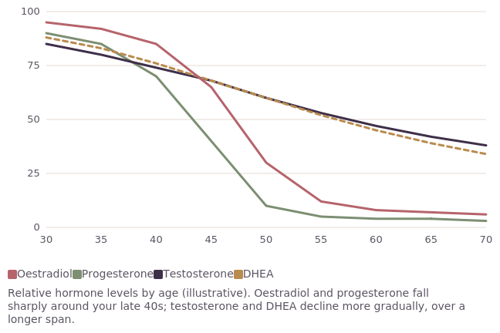
Declining hormones drive much of what gets labelled as “ageing” — partly directly, and partly because symptoms make it harder to stay active, sleep well and look after yourself.
Your heart: the change nobody warns you about
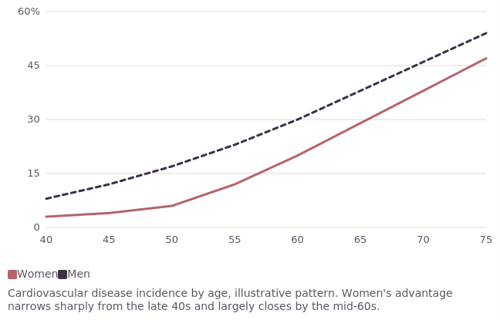
Before menopause, women have a significant natural advantage over men when it comes to cardiovascular disease. That protection isn't permanent — it narrows sharply from the late 40s and early 50s, and by your mid-60s, your risk has largely caught up with men's.
It's a genuinely under-recognised issue. Women often present differently to men when having a heart attack, are under-represented in cardiovascular research, and are offered fewer interventions as a result.
38%
of women die within a year of a heart attack, vs 25% of men
4×
more common: coronary microvascular disease in women
35%
of women have a further heart attack within 6 years, vs 18% of men
Why does this happen? Losing oestrogen affects the cardiovascular system directly — raising blood pressure, stiffening arteries and affecting how blood vessels function — and indirectly, by shifting where you store fat, raising cholesterol and triglycerides, and increasing insulin resistance.
The “window of opportunity”
This is one of the most important, and most misunderstood, findings in menopause medicine. Research consistently shows that starting HRT before age 60, or within 10 years of your final period, is associated with a lower risk of heart disease and death from any cause. Starting HRT much later doesn't show the same benefit. In women in this early window, HRT performs comparably to — or better than — statins and aspirin for reducing cardiovascular risk.
To be clear: current UK guidance is that HRT shouldn't be started purely to prevent heart disease — its primary role is treating your symptoms. But knowing your risk shifts earlier than you might expect, and that timing of treatment matters, is valuable information for the conversation with your doctor.
If your menopause happened early — before 45, whether naturally or through surgery that removed your ovaries —
that risk shift happens sooner too, and the case for discussing HRT with your doctor is stronger, not weaker.
Your bones: the silent shift
Oestrogen normally puts the brakes on bone breakdown. When it falls, that brake is released — and bone loss accelerates fastest in the first five to ten years after your final period, often without any warning signs at all. Osteoporosis is frequently silent until the first fracture happens.
1 in 2
women over 50 will have an osteoporotic fracture
105,000
hip fractures a year in the UK, rising fast
28.7%
die within 12 months of a hip fracture
A fracture is rarely just about the break itself. Vertebral fractures can reduce lung capacity and change posture; hip fractures often mean a long hospital stay and a loss of independence — over half of women aren't back living fully independently 120 days later.
The reassuring part: this is one of the areas where HRT has the strongest, best-established evidence. It reduces the risk of both spine and hip fracture, and — alongside resistance training, adequate protein, calcium and vitamin D, not smoking and moderating alcohol — is one of several tools that genuinely protect your skeleton for the long term.
Bladder and intimate health: the symptom nobody talks about
Vaginal and urinary tissue is packed with oestrogen receptors, which makes it one of the areas hit hardest by menopause — and one of the most under-treated. Dryness, irritation and recurrent urinary tract infections (UTIs) are grouped under a condition called genitourinary syndrome of menopause. Unlike hot flushes, it doesn't tend to improve on its own — left untreated, it typically gets worse over time.
UTIs after menopause aren't a minor inconvenience either. In older women they can trigger confusion, longer hospital stays, and in serious cases, bloodstream infection. Around 7 in every 100 postmenopausal women have a UTI each year, and once you've had one, another one within six months is common.
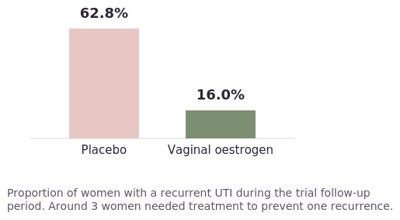
In a randomised trial, vaginal oestrogen cut the risk of a repeat UTI by more than half.
Brain fog: real, but not a warning sign of dementia
If you've found yourself losing words mid-sentence or walking into a room and forgetting why, you're not imagining it, and you're not alone. Oestrogen affects how the brain uses energy, and falling levels — combined with disrupted sleep from night sweats — genuinely affect concentration, memory and word-finding in perimenopause. This is now recognised as a real, distinct symptom, not a sign that something is seriously wrong.
Brain fog is not the same as dementia, and it's worth unpacking where that fear comes from. A study from the early 2000s (the Women's Health Initiative Memory Study) linked a particular type of HRT, started in women over 65, to increased dementia risk — and this became the source of much of the lasting anxiety about HRT and the brain. But it studied women starting HRT more than a decade later in life than most women do today, using a formulation that's now less commonly prescribed.
More recent, larger evidence tells a more reassuring — if still incomplete — story:
● A major 2025 review of over a million women found no convincing evidence that HRT either raises or lowers dementia risk.
● A 2026 UK Biobank study following over 180,000 women for an average of 13 years found HRT use of a year or more was associated with a 10% lower risk of dementia and 16% lower risk of Alzheimer's — strongest in women who started in their mid-40s to mid-50s.
The honest summary: brain fog is real and treatable, the old fear doesn't reflect how HRT is used today, and while newer evidence is encouraging, it isn't yet strong enough to prescribe HRT specifically to prevent dementia.
What about testosterone and DHEA?
Testosterone isn't just a male hormone — women produce it too, and it declines gradually from years before menopause. The strongest evidence for testosterone therapy in women is for low sexual desire that's causing you distress (known as HSDD); a trial of three months is considered reasonable when that's the concern. Its use for other symptoms — low energy, mood, concentration — is plausible and an active area of interest, but not yet proven, so we're cautious about promising results we can't yet back with evidence.
DHEA is an adrenal hormone that also declines with age and stress, and low levels have been linked to low libido, fatigue and low mood. It's biologically interesting, but the evidence for supplementing it is much less developed than for oestrogen or testosterone — worth discussing, but not a guaranteed fix.
How we think about getting hormones right
“Optimising hormones” can sound like a chase for perfect numbers on a blood test. It isn't, and shouldn't be. Three principles guide how we approach hormone therapy at the clinic:
1. Treat a genuine need, not just a number
We prescribe where there's a clear symptom or health rationale — not simply because a lab value looks low.
2. Aim for balance, not maximum levels
The goal is to restore levels similar to a healthy, premenopausal woman — not to push levels to the top of the range or beyond.
3. Look at the whole picture, not just symptoms
Menopause is a natural moment to review your broader health — blood pressure, bone risk, cardiovascular risk factors — alongside treating how you feel day to day.
What HRT is — and what it isn't
HRT is...
Effective treatment for menopausal symptoms
Protective for bone strength
Potentially beneficial for heart health in the right woman, at the right time
Individualised to you
One part of a healthy-ageing plan
HRT isn't...
A universal anti-ageing treatment
A replacement for exercise or good nutrition
Prescribed solely to prevent heart disease
A “one dose fits all” prescription
The whole plan on its own
The goal isn't to stop the clock. It's to avoid adding unnecessary hormone deficiency on top of natural ageing — and to give your body the support it needs to age as well as it can.
The bigger picture: more than a prescription
Because it's tempting to think “HRT solves ageing,” it's worth being explicit that it doesn't — and shouldn't be expected to. A genuine healthy-ageing approach around menopause looks at several areas together:
● Hormone health — individualised HRT where it's appropriate for you
● Cardiovascular health — blood pressure, cholesterol, activity, and timing of any hormone treatment
● Bone and muscle health — resistance training, protein intake, calcium and vitamin D
● Metabolic health — weight, blood sugar and insulin sensitivity
● Sleep — treating the night sweats and disruption driving poor sleep
● Sexual and urogenital health — local oestrogen, and addressing low desire if it's troubling you
● Mental wellbeing — support for mood and anxiety, not just symptom-checking
● Lifestyle — alcohol, smoking, exercise and stress management
Seeing menopause this way — as a wake-up call and a genuine opportunity, rather than just an inconvenience to manage — changes what's possible for the next third of your life.
Ready to talk about your options?
Every woman's hormones, history and priorities are different — this article is general information, not a personal prescription. At The Women's Hormone Clinic, we take the time to look at your whole picture and build a plan that's right for you.
This article is intended for general information and education, and does not replace individual medical advice. If you have questions about your own symptoms, risk factors or treatment options, please book a consultation.
Dr Rebecca Poet is a UK GP specialising in women's hormonal health, menopause care and healthy ageing, and the founder of The Women's Hormone Clinic. She trained at Guy's and St Thomas' (University of London) and holds additional qualifications through the British Menopause Society and the Marion Gluck Training Academy.