ADHD and Perimenopause: When Two Worlds Collide
Many women find that their ADHD symptoms become more noticeable, or harder to manage, during the perimenopausal transition. For some women, this is also the stage of life when ADHD first comes to clinical attention, having gone unrecognised for decades.

This is not a coincidence, and it is not a personal failing. There is a real biological relationship between the hormonal changes of perimenopause and the way ADHD presents. Understanding that connection can be the key to getting the right support.
The Link Between Hormones and Attention
Oestrogen does far more than regulate the menstrual cycle. It also influences key neurotransmitters in the brain, including dopamine and noradrenaline. These two chemical messengers are central to attention, motivation, executive functioning and emotional regulation, the very areas most affected in ADHD.
During perimenopause, oestrogen levels begin to fluctuate and gradually decline. As they do, their supportive effect on dopamine and noradrenaline becomes less consistent. For a woman with ADHD, whose brain already works differently in these systems, this can make existing symptoms more pronounced. Focus may become harder, organisation more effortful, and emotions more difficult to regulate.
What the Emerging Research Shows
This is an area of growing research interest, and the early findings are striking.
A large population-based study found that women with ADHD experience more severe perimenopausal symptoms than women without ADHD (Jakobsdottir Smari et al., 2025). The same research raised the possibility that women with ADHD may experience clinically significant menopausal symptoms at a younger age, prompting important questions about whether they enter the menopausal transition earlier, and whether there may be links with premature ovarian insufficiency (POI). This is not yet established and further research is needed, but it is an area we will be watching closely, and one we may explore in a future blog.
Separately, survey research has found that many women report their ADHD symptoms worsening during the menopausal transition (Osianlis et al., 2025). In other words, women have been describing this experience, and the evidence is now beginning to catch up with them.
ADHD or Perimenopause? The Overlap
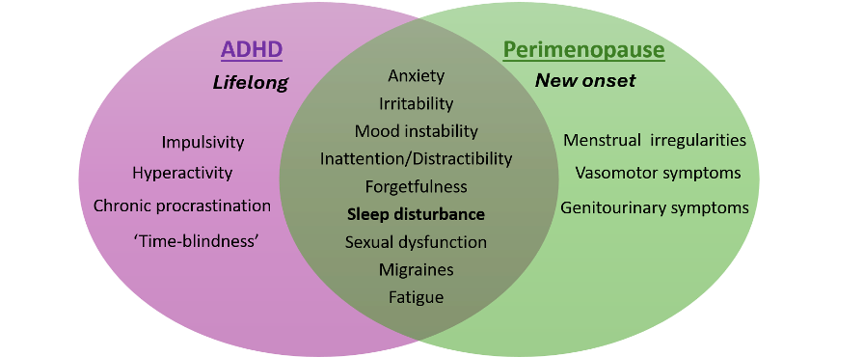
One of the reasons this can be confusing is that ADHD and perimenopause share several cognitive symptoms. Brain fog, forgetfulness, poor concentration and reduced executive functioning can all appear in both.
This overlap means the two can be hard to tell apart, and can easily be mistaken for one another. A woman might assume her difficulties are simply menopause, when underlying ADHD is also playing a part. Equally, cognitive changes might be attributed to ADHD when hormones are a significant contributor. Often, both are involved.
Overlapping symptoms of ADHD and perimenopause
How a Specialist Tells Them Apart
Distinguishing between ADHD and menopause-related cognitive change requires a careful, expert assessment. Some of the clues a specialist looks for include:
- ADHD symptoms are present from childhood, even if they were never recognised or did not cause obvious difficulty at the time. A lifelong pattern points towards ADHD.
- A history of hyperactivity or impulsivity, whether in childhood or currently, can be a useful clue, as these are not generally part of the perimenopausal picture.
- Menstrual irregularity, hot flushes and night sweats, sleep disturbance and other physical symptoms support a hormonal contribution.
In practice, ADHD and perimenopause very commonly coexist, with the hormonal changes of midlife making an underlying ADHD more noticeable or more impairing than it was before.
Why Personalised Assessment Matters
Because the two are so intertwined, effective help depends on understanding the full picture. Management may involve addressing hormonal factors, ADHD, or both together, and getting that balance right requires a clinician with expertise in both areas.
This is exactly the kind of holistic, personalised assessment we believe every woman deserves. Too often, women in midlife are left to piece together their own explanations, or are treated for one thing while the other is missed entirely.
If your focus, memory or emotional regulation has changed, and you are not sure whether it is your hormones, ADHD, or both, you do not have to work it out alone.
References
Jakobsdottir Smari U, et al. (2025). Perimenopausal symptoms in women with and without attention-deficit/hyperactivity disorder: a population-based cohort study. European Psychiatry, 68, e101.
Osianlis F, et al. (2025). Hormonal influences on ADHD symptoms across the female lifespan: findings from an international survey. Journal of Psychiatric Research.
For informational purposes only. Always seek personalised advice from a qualified clinician.