Menopause Care in the UK and USA: why access can look so different.
How does access to menopause care in the UK compare with the United States? Conversations with international colleagues at the World Congress on Menopause in Rio brought that question into focus for me. In particular, they prompted me to look more closely at what happens when women rely on publicly funded care. For menopausal hormone therapy (MHT, often called HRT), the routes to treatment can look very different.

Understanding Medicare and Medicaid
The first thing to understand is that the US has no equivalent of the NHS. There are two main publicly funded programmes:
- Medicare – a federal programme mostly for people aged 65 and over. This means the vast majority of women going through perimenopause and menopause, typically in their 40s and early 50s, are simply not eligible for it.
- Medicaid – a programme for people on low incomes, run separately by each of the 50 states, each with its own list of covered medicines.
Crucially, neither Medicare nor Medicaid is required to cover menopause care. Whether a woman can get MHT depends on which state she lives in and what her particular plan's drug list includes. Generic oestradiol is covered by most Medicaid plans, but coverage of other products, and the hoops a woman must jump through to get them, vary widely.
How insurance can affect access to treatment
The impact is real. A major US study published in JAMA Network Open in July 2026 found that, among menopausal women with no medical reason to avoid MHT, those covered by Medicaid were around 50% less likely to use it than women with private insurance. The researchers also found that the type of insurance helped explain racial differences in who receives menopause treatment.
Warnings and availability: a changing picture
American women have also been living with the long shadow of the "black box" warning on HRT – the strongest warning the US regulator can put on a medicine – which since the early 2000s has warned of breast cancer, heart disease and dementia on the pack. Only now is that changing: the US Food and Drug Administration (FDA) began revising these labels in late 2025, and approved updated labels for more products, including oestradiol patches, as recently as October 2026. Supplies of patches have also been under pressure as demand rises.
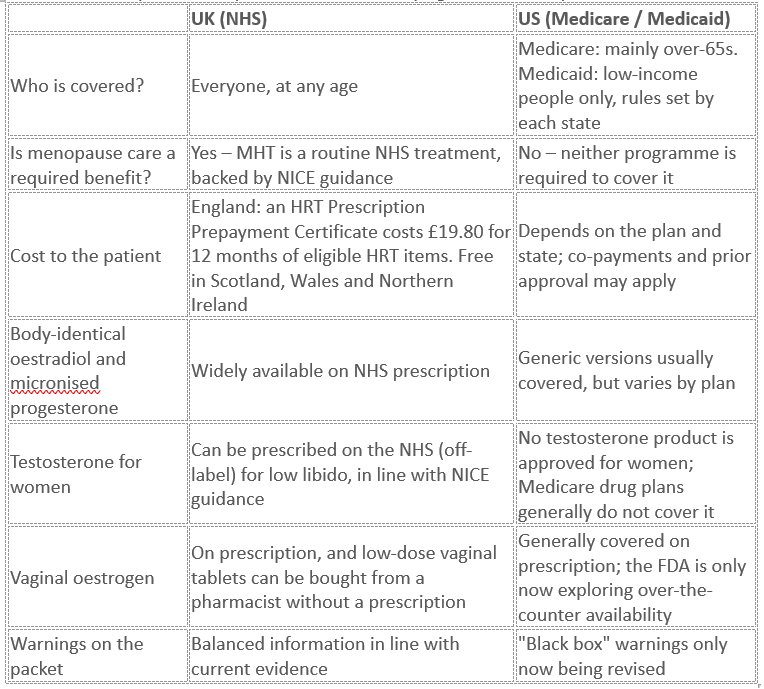
UK and US menopause care at a glance
Here is how the picture compares for a woman relying on the state system:
What this means for women in the UK
These differences are a reminder that access to menopause care is not simply about which medicines exist. Eligibility, prescription costs and the rules of a particular health plan can all shape whether a woman receives treatment. The comparison here focuses on NHS care and the US Medicare and Medicaid programmes, rather than every route through either healthcare system.
For women in the UK, there is much to value in having an NHS route to menopause treatment. That does not mean access is always straightforward: long waits, uneven provision and product shortages still need attention. We can recognise the value of the NHS while continuing to ask for better menopause care.
If you would like to discuss your own menopause symptoms and treatment options, please click here to book your consultation with the Women’s Hormone Clinic.
Further reading
- Chesnokova A, et al. Insurance Type and Menopausal Hormone Therapy Use Among US Women. JAMA Network Open, July 2026
- US Department of Health and Human Services – FDA advances menopause care with hormone therapy labeling and access (October 2026)
- NHS Business Services Authority – NHS Hormone Replacement Therapy Prescription Prepayment Certificate (HRT PPC)
- NICE guideline NG23 – Menopause: identification and management